
ST1099

Anti-TORC2 (454-607) Rabbit pAb
liquid, Calbiochem®
製品名
Anti-TORC2 (454-607) Rabbit pAb, liquid, Calbiochem®
biological source
rabbit
antibody form
serum
antibody product type
primary antibodies
clone
polyclonal
form
liquid
does not contain
preservative
species reactivity
human, mouse, rat
manufacturer/tradename
Calbiochem®
storage condition
OK to freeze
dilution
(Immunoblotting (1:2000)
Immunoprecipitation (1:100))
isotype
IgG
shipped in
wet ice
storage temp.
2-8°C
target post-translational modification
unmodified
Quality Level
Analysis Note
Positive Control
Primary rat hepatocytes, HepG2, NIH3T3, Min6, and FAO cells
Primary rat hepatocytes, HepG2, NIH3T3, Min6, and FAO cells
Application
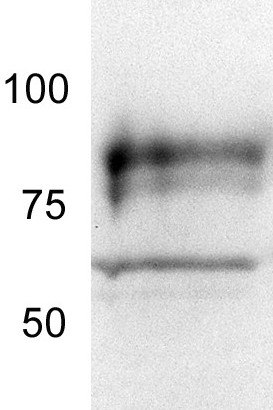
Immunoblotting (1:2000, see comments)
Immunoprecipitation (1:100, see comments)
Disclaimer
Toxicity: Standard Handling (A)
General description
Rabbit polyclonal antibody supplied as undiluted serum. Recognizes the ~79-85 kDa TORC2 protein.
Recognizes the ~79-85 kDa TORC2 protein in primary hepatocytes, HepG2, NIH3T3, Min6, and FAO cells.
TORCs (Transducers Of Regulated cAMP Response Element-Binding (CREB) protein) are members of a conserved family of co-activators that enhance CRE-dependent transcription by a phosphorylation-independent interaction with the bZIP DNA binding/dimerization domain of CREB. Studies suggest that TORC phosphorylation and nuclear/cytoplasmic shuttling play an important role in the regulation of gluconeogenesis by cAMP.
This Anti-TORC2 (454-607) Rabbit pAb is validated for use in Immunoblotting, Immunoprecipitation for the detection of TORC2 (454-607).
Immunogen
Human
a recombinant protein consisting of amino acids 454-607 of mouse TORC2 fused to GST
Other Notes
Screaton, R.A., et al. 2004. Cell119, 61.
This antibody has been used to detect endogenous TORC2 by immunoblotting. For immunoprecipitation, 4 µl antibody in a total volume of 400 µl has been tested. May also detect a protein at ~60 kDa, which may be a degradation product of TORC2. Antibody should be titrated for optimal results in individual systems.
Physical form
Undiluted serum.
Preparation Note
For long-term storage, aliquot and freeze (-20°C). In the case of storage at -20°C, avoid freeze/thaw cycles.
Legal Information
CALBIOCHEM is a registered trademark of Merck KGaA, Darmstadt, Germany
適切な製品が見つかりませんか。
製品選択ツール.をお試しください
保管分類
10 - Combustible liquids
wgk
WGK 1
flash_point_f
Not applicable
flash_point_c
Not applicable
試験成績書(COA)
製品のロット番号・バッチ番号を入力して、試験成績書(COA) を検索できます。ロット番号・バッチ番号は、製品ラベルに「Lot」または「Batch」に続いて記載されています。
Julie A Highland et al.
American journal of physiology. Cell physiology, 307(7), C611-C621 (2014-08-01)
Entrainment of the intrinsic suprachiasmatic nucleus (SCN) molecular clock to the light-dark cycle depends on photic-driven intracellular signal transduction responses of SCN neurons that converge on cAMP response element-binding protein (CREB)-mediated regulation of gene transcription. Characterization of the CREB coactivator
Pablo E Hollstein et al.
Cancer discovery, 9(11), 1606-1627 (2019-07-28)
Mutations in the LKB1 (also known as STK11) tumor suppressor are the third most frequent genetic alteration in non-small cell lung cancer (NSCLC). LKB1 encodes a serine/threonine kinase that directly phosphorylates and activates 14 AMPK family kinases ("AMPKRs"). The function
Jae Min Lim et al.
Molecular & cellular proteomics : MCP, 22(10), 100637-100637 (2023-08-31)
cAMP response element-binding protein (CREB) regulated transcriptional coactivator 2 (CRTC2) is a critical transcription factor that maintains glucose homeostasis by activating CREB. Energy homeostasis is maintained through multiple pathways; therefore, CRTC2 may interact with other transcription factors, particularly under metabolic
Lorna I F Smith et al.
Journal of neuroendocrinology, 33(1), e12920-e12920 (2020-12-15)
The activation and nuclear translocation of cAMP-response element binding protein (CREB)-regulated transcription coactivator (CRTC)2 occurs in the rat adrenal gland, in response to adrenocorticotrophic hormone (ACTH) and stressors, and has been implicated in the transcriptional regulation of steroidogenic acute regulatory
Ningyuan Sun et al.
The Journal of biological chemistry, 294(25), 9722-9733 (2019-05-10)
Bone is a highly metabolic organ that undergoes continuous remodeling to maintain its structural integrity. During development, bones, in particular osteoblasts, rely on glucose uptake. However, the role of glucose metabolism in osteocytes is unknown. Osteocytes are terminally differentiated osteoblasts
グローバルトレードアイテム番号
| カタログ番号 | GTIN |
|---|---|
| ST1099-50ULCN | 04055977224436 |
ライフサイエンス、有機合成、材料科学、クロマトグラフィー、分析など、あらゆる分野の研究に経験のあるメンバーがおります。.
製品に関するお問い合わせはこちら(テクニカルサービス)