
DR1002

PhosphoDetect Anti-ATM (pSer¹⁹⁸¹) Mouse mAb (10H11.E12)
liquid, clone 10H11.E12, Calbiochem®
別名:
Anti-Ataxia Telangiectasia, Phospho-Specific (Ser¹⁹⁸¹)
biological source
mouse
antibody product type
primary antibodies
clone
10H11.E12, monoclonal
form
liquid
contains
≤0.1% sodium azide as preservative
species reactivity
human, mouse
manufacturer/tradename
Calbiochem®
storage condition
OK to freeze, avoid repeated freeze/thaw cycles
isotype
IgG1
shipped in
wet ice
storage temp.
−20°C
Quality Level
General description
Protein G purified mouse monoclonal antibody. Recognizes the ~370 kDa ATM protein phosphorylated at Ser1981.
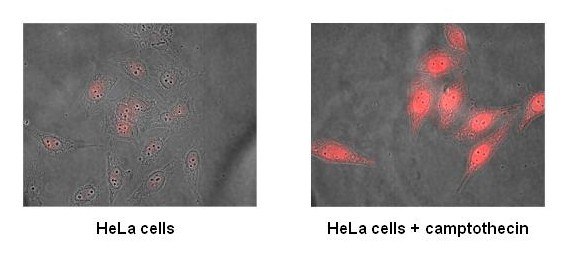
Recognizes the ~370 kDa ATM protein phosphorylated on Ser1981 in camptothecin-treated HeLa cells. Sold under license of U.S. Patent 7,108,992.
This PhosphoDetect Anti-ATM (pSer¹⁹⁸¹) Mouse mAb (10H11.E12) is validated for use in Immunoblotting, Immunocytochemistry for the detection of ATM (pSer¹⁹⁸¹).
Immunogen
Human
a synthetic phosphopeptide (SLAFEEGpSQSTTISS) corresponding to amino acids 1974-1988 surrounding the Ser¹⁹⁸¹ phosphorylation site of human ATM
Application
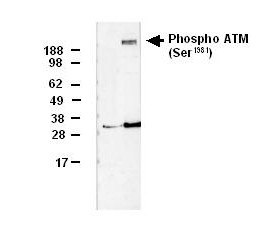
Immunoblotting (0.5 g/ml)
Immunocytochemistry (1.5 g/ml)
Packaging
Please refer to vial label for lot-specific concentration.
Physical form
In PBS.
Preparation Note
Following initial thaw, aliquot and freeze (-20°C).
Analysis Note
Positive Control
HeLa cells treated with camptothecin (Cat. No. 208925)
HeLa cells treated with camptothecin (Cat. No. 208925)
Other Notes
Does not detect the unphosphorylated protein. Use 5% milk in TBS-T for blocking; the use of BSA is not recommended. The use of PBS-T is not recommended, as phosphate-containing buffers can contribute to high background with phosphospecific antibodies. Antibody should be titrated for optimal results in individual systems.
Horejsi, Z., et al. 2004. Oncogene23, 3122.
Abraham, R.T. 2003. Genes Dev.15, 2177.
Bakkenist, C.J. and Kastan, M.B. 2003. Nature421, 499.
Shiloh, Y. 2003. Nat. Rev. Cancer3, 155.
Abraham, R.T. 2003. Genes Dev.15, 2177.
Bakkenist, C.J. and Kastan, M.B. 2003. Nature421, 499.
Shiloh, Y. 2003. Nat. Rev. Cancer3, 155.
Legal Information
Sold under license of U.S. Patent 7,108,992.
CALBIOCHEM is a registered trademark of Merck KGaA, Darmstadt, Germany
Disclaimer
Toxicity: Irritant (B)
適切な製品が見つかりませんか。
製品選択ツール.をお試しください
保管分類
10 - Combustible liquids
wgk
WGK 1
flash_point_f
Not applicable
flash_point_c
Not applicable
適用法令
試験研究用途を考慮した関連法令を主に挙げております。化学物質以外については、一部の情報のみ提供しています。 製品を安全かつ合法的に使用することは、使用者の義務です。最新情報により修正される場合があります。WEBの反映には時間を要することがあるため、適宜SDSをご参照ください。
DR1002-50UG: + DR1002-ML: + DR1002-MG:
jan
試験成績書(COA)
製品のロット番号・バッチ番号を入力して、試験成績書(COA) を検索できます。ロット番号・バッチ番号は、製品ラベルに「Lot」または「Batch」に続いて記載されています。
Hongyu Chen et al.
Journal of cellular physiology, 234(7), 11871-11881 (2018-11-28)
Acquired resistance to cytotoxic antineoplastic agents is a major clinical challenge in tumor therapy; however, the mechanisms involved are still poorly understood. In this study, we show that knockdown of CtIP, a corepressor of CtBP, promotes cell proliferation and alleviates
Xiaoyao Yang et al.
International journal of molecular medicine, 42(4), 1945-1954 (2018-08-08)
Utilizing the energy released from the nuclear fusion of deuterium with tritium (D‑T) may be an important method of supplying energy in the future. The ionizing radiation emitted from nuclear fusion is a potential health risk to humans, including scientists
Tatyana V Pospelova et al.
Cell cycle (Georgetown, Tex.), 8(24), 4112-4118 (2009-12-01)
Cellular senescence is currently viewed as a response to DNA damage. In this report, we showed that non-damaging agents such as sodium butyrate-induced p21 and ectopic expression of either p21 or p16 cause cellular senescence without detectable DNA breaks. Nevertheless
Wissam Assaily et al.
Molecular cell, 44(3), 491-501 (2011-11-08)
The p53 protein is activated by stress signals and exhibits both protective and death-promoting functions that are considered important for its tumor suppressor function. Emerging evidence points toward an additional role for p53 in metabolism. Here, we identify Lpin1 as
Nibedita Patel et al.
Scientific reports, 7(1), 4263-4263 (2017-06-29)
The B-lymphoma Moloney murine leukemia virus insertion region-1 protein (BMI1) acts as an oncogene in various cancers, including breast cancer. Recent evidence suggests that BMI1 is rapidly recruited to sites of DNA double strand breaks where it facilitates histone H2A
ライフサイエンス、有機合成、材料科学、クロマトグラフィー、分析など、あらゆる分野の研究に経験のあるメンバーがおります。.
製品に関するお問い合わせはこちら(テクニカルサービス)